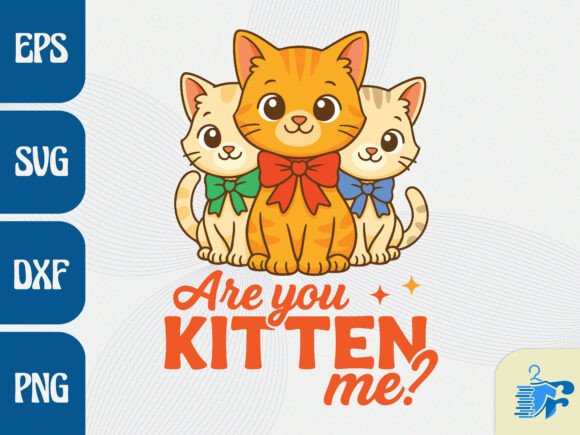
Are You KITTEN, Me
A Playful Design That Stitches Well—If You Know Its Sweet Spot
I pulled up Are You KITTEN, Me last week while prepping a batch of custom embroidered tote bags for a local nursery boutique. The client wanted something lighthearted but not cutesy—whimsical enough for baby showers, grounded enough for everyday use. Right away, the design’s charm clicked: clean lines, balanced negative space, and that clever typographic twist in the “KITTEN” that feels intentional, not gimmicky. It’s not just a pun—it’s a personality. As a designer who’s stitched hundreds of text-based graphics, I appreciate how rarely lettering lands this well in embroidery-ready form.
First Impressions: Mood, Shape, and Embroidery Readiness
The layout is compact but breathable—no cramped letters or overlapping strokes. That matters. When you’re working with satin stitch outlines or tight fill areas on cotton twill or medium-weight canvas, airflow between elements prevents thread buildup and puckering. The “KITTEN” is stylized just enough to read clearly at 3–4 inches wide, and the “Me” sits low and centered like a quiet wink. No extra flourishes, no unnecessary curls—just smart spacing and consistent stroke weight. That simplicity translates directly to reliable stitch performance.
It reads as friendly, approachable, and gently humorous—not ironic, not sarcastic, not trying too hard. That tone works beautifully for baby embroidery, nursery decor, and personalized gifts where warmth matters more than edge. But it also holds up on sweatshirt embroidery or aprons for small-batch cafés or bakeries—places where handmade product meets real-world wear.
Where Are You KITTEN, Me Shines (and Where It Needs a Little Help)
I ran it on three fabrics: a midweight organic cotton tote, a fleece-lined baby onesie, and a structured cotton twill cap. Here’s what stood out:
- Tote bags & pillow covers: Perfect scale and clarity. The letterforms stayed crisp even at 3.5 inches tall. Stitch density felt moderate—not sparse, not heavy—so the fabric didn’t stiffen unnaturally.
- Baby clothes & tea towels: Worked best with lightweight cutaway stabilizer and 40-weight thread. On the onesie, I used a soft tear-away underneath and a light topping—no skipped stitches, no shadowing through the fabric.
- Caps & curved surfaces: Required careful hooping and reduced stitch speed. The “T” and “N” corners held up well, but I’d avoid going smaller than 2.75 inches on caps unless you’re using an ultra-precise commercial machine.
That said—Are You KITTEN, Me isn’t magic on every surface. On thin jersey or stretchy fabric? Proceed with caution. The clean lines rely on stability; without proper stabilizer, those sharp corners can distort. On dark fabric, test your thread contrast first—light gray or heather thread on navy reads beautifully, but pale yellow can disappear. And if you’re planning layered garments (like an embroidered patch sewn onto a denim jacket), make sure the design’s fill stitch areas aren’t so dense they’ll add unwanted bulk.
Real Impact: How This Design Moves the Needle for Your Business
As an Etsy seller and craft fair vendor, I judge designs not just by how they stitch—but by how they sell. Are You KITTEN, Me consistently draws smiles. At our last pop-up, a customer paused at the tote display, pointed, and said, “That’s *me*—but with cat energy.” That kind of instant recognition? That’s gold. It builds connection fast—especially for personalized gifts, holiday embroidery, or boutique branding where emotional resonance matters more than technical perfection.
It also supports brand consistency. Whether you’re selling embroidered patches, custom apparel, or digital embroidery files, this design fits neatly into a cohesive collection—think matching mugs, tea towels, and onesies—all anchored by the same visual voice. And because it’s built for clarity over complexity, it photographs well in printable mockups and digital product previews. No pixelation, no fuzzy edges. Just clean, confident presentation.
Practical Designer Notes Before You Stitch
Before you load Are You KITTEN, Me into your machine or list it in your shop, take five minutes to do these:
- Test on scrap fabric—same type and weight as your final project.
- Check thread color contrast on both light and dark backgrounds. Print a black-and-white mockup to verify legibility.
- Confirm hoop size compatibility. If you’re using a 4x4 hoop, measure the design width—some versions may need trimming or repositioning.
- Inspect small details: Are the inner curves of the “K” and “E” open enough for smooth satin stitch? Does the “I” have enough width to avoid needle deflection?
- Verify licensing. Since this is a Graphics file sold as part of T-Shirt Designs, confirm whether commercial embroidery rights are included—especially if you plan to sell finished products or resell the digital embroidery file.
Also: don’t skip stabilizer. Even on stable fabrics, a light layer keeps those clean lines from drifting. And if you’re offering this as part of a custom apparel service, show clients a photo of the design stitched—not just the PNG preview. That transparency builds trust and sets realistic expectations.
Final Thought: A Design That Works Because It Doesn’t Try Too Hard
Are You KITTEN, Me succeeds not by being flashy, but by being thoughtful. It respects the limits of thread, fabric, and human attention—and rewards the maker who pays attention to detail. It’s equally at home on a baby onesie gifted at a shower, a staff apron for a cat café, or a limited-run tote for a small shop launch. It doesn’t shout. It invites. And in embroidery—where every stitch carries intention—that’s exactly what makes a design worth keeping in your library.